
What size air conditioner do I need? Room-by-room kW for Brisbane homes
11 min readUpdated Reviewed by Tom, owner and licensed electrician, on
Split systems are sold by kilowatts of cooling, and the right number depends on the room more than the house. This guide turns floor area into kW with two published manufacturer methods, adjusts for Brisbane's hot, humid summers, works through three example rooms, and covers the electrical check every new split system raises.
The short answer
Match the unit's cooling capacity in kW to the room's floor area, then adjust for sun, ceiling height and insulation. Rinnai's sizing guide puts rooms up to 20 square metres at 2.5 kW, rooms of 20 to 40 square metres at 3.5 kW, and larger living areas at 5.0 kW or more. Brisbane sits in the Hot zone of the Energy Rating label; for a unit used mainly for cooling, size on the 35°C cooling figure, and lean to the larger size for west-facing rooms, high ceilings and poorly insulated homes.
In this guide13 sections
Sizing a split system, room by room
Measure the floor area first: it sets the starting kW
The starting point for sizing a split system is the floor area of the room it will cool. Measure the length and width in metres and multiply them. For an open-plan space, add the areas of every part that shares the same air.
The Energy Rating program, run by Australian and New Zealand governments, says the right size depends on the space, the building's wall material, insulation and windows, and the climate, and it recommends professional advice before deciding. Capacity is printed in kilowatts (kW) of cooling output, and the higher the kW figure, the more cooling the system provides.
Write down two more things while you measure: the ceiling height, and the direction the room's main windows face. Floor area, ceiling height and window orientation are the inputs the two charts in this guide use between them.
Two manufacturer methods give different answers, so check both
Published room charts do not agree, so one number from one website is a weak basis for buying. Rinnai's buyer's guide groups rooms into bands at a standard 2.4 metre ceiling: up to 20 square metres for 2.5 kW, 20 to 40 square metres for 3.5 kW, 40 to 60 square metres for 5.0 to 6.0 kW, and 60 square metres and over for 7.0 to 9.0 kW.
ActronAir uses a formula instead. Multiply the floor area by 150 watts per square metre at a 2.4 metre ceiling, 160 watts at 2.7 metres, or 175 watts at 3 metres.
For a 20 square metre room, Rinnai's band says 2.5 kW, while ActronAir's formula gives 3.0 kW. The gap grows with the room. The table below sets the two methods side by side. Where they disagree, the room's sun, ceiling height and insulation decide which end of the range to choose.
Brisbane rooms: size up for west sun, high ceilings and thin insulation
Three features push a Brisbane room towards the larger size. West-facing windows take the harshest afternoon sun, according to Rinnai's guide, and large or unshaded windows facing any direction add to the load. Ceilings of 2.7 metres or higher hold more air, and Rinnai suggests sizing up for them; ActronAir's formula rises from 150 to 175 watts per square metre between a 2.4 and a 3 metre ceiling. Rinnai also notes that older homes with little or no ceiling insulation may need more capacity.
Climate adds to it. The Energy Rating label puts Brisbane in its Hot zone, where the summer cooling season often comes with high humidity. Thin or missing ceiling insulation, a high or raked ceiling, or west-facing windows can each tip a room into the next size. As a rule of thumb, not a published rule: if a room has two of these features and sits near the top of a band, choose the next size up.
Worked example: a 12.6 square metre bedroom suits 2.5 kW
A bedroom of 3.5 by 3.6 metres has a floor area of 12.6 square metres. With a standard 2.4 metre ceiling, Rinnai's chart places it well inside the band of up to 20 square metres for 2.5 kW. ActronAir's formula gives 12.6 times 150 watts, about 1.9 kW, so a 2.5 kW unit has headroom for hot nights.
The answer changes only when the bedroom carries extra heat load. Rinnai's guide says a room that gets a lot of sun, or has little or no ceiling insulation, may need to size up to the next capacity, so a west-facing bedroom of this size under a poorly insulated ceiling may need 3.5 kW even though the formula leaves about 0.6 kW of margin. A larger main bedroom of 18 to 20 square metres with the same features is the clearer case for stepping up to 3.5 kW: the formula already reaches 2.7 to 3.0 kW at those sizes before any allowance for afternoon sun.
Worked example: a west-facing 25 square metre living room leans above 4.0 kW
A living room of 5 by 5 metres is 25 square metres. On Rinnai's chart that is a 3.5 kW room. Add a 2.7 metre ceiling and ActronAir's formula gives 25 times 160 watts, or 4.0 kW, already above 3.5 kW before allowing for afternoon sun through west-facing windows.
Here the two methods point to different units, and the room's features settle it. A 3.5 kW unit would run near its limit on a hot afternoon, which is the undersizing problem the Energy Rating program describes: the unit works harder and may not hold the set temperature. ActronAir also notes that air conditioners lose some cooling capacity once outdoor temperatures pass 35°C. In our judgment, not a published rule, this room suits the next size above the formula's 4.0 kW rather than 3.5 kW. If the same room faced east under a 2.4 metre ceiling, the formula would give 3.75 kW, and Rinnai's 3.5 kW becomes a closer call.
Worked example: a 48 square metre open-plan area under a raked ceiling can need 7.0 kW or more
An open-plan kitchen, dining and family area of 8 by 6 metres is 48 square metres. Rinnai's chart puts it in the 5.0 to 6.0 kW band at a 2.4 metre ceiling. Under a raked ceiling averaging about 3 metres, ActronAir's formula gives 48 times 175 watts, about 8.4 kW.
A gap of more than 2 kW is too wide to settle with a chart. Rinnai's guide suggests considering sizing up for ceilings of 2.7 metres or more, which can move the room into its 7.0 to 9.0 kW band and closer to the formula. Large areas also open other options: Rinnai notes that multi split and ducted systems serve several rooms from one outdoor unit, and that ducted systems always need an onsite assessment. For a room this size, ask any installer how they arrived at the capacity in the quote.
Too big or too small: both cost more
A split system that is the wrong size costs more either way, according to the Energy Rating program. An undersized unit works harder to cool the room and may not reach the set temperature, which can cost more to run. An oversized unit costs more upfront and in running costs.
In a humid climate the oversized case has a second problem. Rinnai's guide says oversized systems cool the room too quickly and switch off before they have properly removed the humidity. ActronAir adds that the resulting on and off cycle can use much more power than a correctly sized unit. Undersized units, on Rinnai's account, run constantly, struggle to reach the set temperature and wear out faster.
The aim is the size that matches the room's real heat load, not the biggest unit the budget allows. For what else shapes the price of an install, read the cost guide.
Reading the energy label: size on the 35°C cooling figure
The Zoned Energy Rating Label shows capacity at the top. For a unit used mainly for cooling, the Energy Rating program's guide for installers says to size on the cooling capacity measured at 35°C. Brisbane is listed in the label's Hot zone, so read the Hot zone star rating and energy figures, not the Average or Cold ones.
Choose the size first, then compare stars between models of that size. A larger unit uses more electricity than a smaller one with the same star rating, so stars only compare like with like. To estimate running cost, multiply the label's yearly kWh figure for your zone by your tariff in dollars per kWh, which is on your electricity bill.
How the unit is run matters too. The Queensland Government suggests a cooling set point of 24 to 26°C, and says each extra degree of cooling could add around 5 to 10 percent to electricity use.
The electrical check: circuit and switchboard
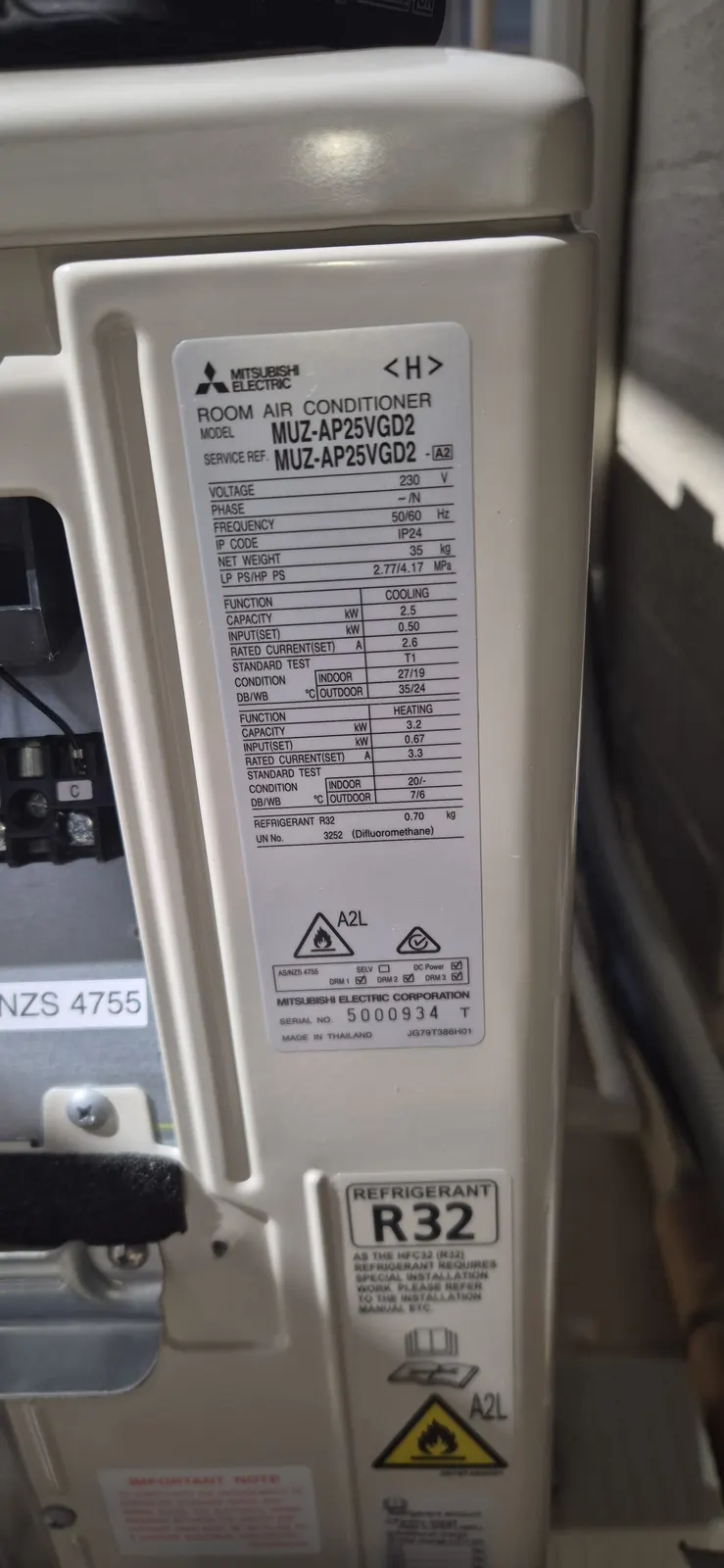
Manufacturer instructions can call for a dedicated circuit. Mitsubishi Electric's operating manual for its MSZ-AP wall units says to provide an exclusive circuit for the air conditioner's power supply and to observe the breaker capacity, and warns that a non-dedicated supply may cause overheating or fire. The Energy Rating program also says installers can advise on any electrical work a new system needs.
This is where the owner's part stops. In Queensland, appliances that must be hard-wired have to be connected by a licensed electrician, and anyone doing electrical work needs a licence authorising it, according to the Electrical Safety Office. Running a new circuit, adding a breaker or altering a switchboard is licensed work. The refrigerant side is licensed as well: the Australian Refrigeration Council says only licensed technicians can legally install a fluorocarbon-gas air conditioner.
When to call a licensed electrician: call Tom on 0401 456 987.
Next step: measure each room, then ask for a sizing check
Before you ask for quotes, write down each room's length, width and ceiling height, and the direction its main windows face. The Australian Refrigeration Council suggests taking room measurements with you when you shop, and the Energy Rating program suggests talking to several suppliers or installers about size, running costs and placement. AIRAH's FairAir calculators, linked from energy.gov.au, give an independent second estimate.
Tom's Air Conditioning & Electrical is a licensed electrical contractor (licence REC 13541) and split system installer based in Warner, covering the Pine Rivers district, Moreton Bay and North Brisbane. The room size, the circuit and the switchboard are questions one licensed business can look at together. Send your measurements with the quote request, and ask which capacity the quote is based on and why.
At a glance
Scroll the table sideways to see every column.
| Factor | Rinnai room band | ActronAir formula (150 W per m²) | Typical rooms (Rinnai) |
|---|---|---|---|
| 2.5 kW | Up to 20 m² | Up to about 17 m² | Bedroom, study, small kitchen |
| 3.5 kW | 20 to 40 m² | Up to about 23 m² | Bedroom with ensuite, small lounge |
| 5.0 to 6.0 kW | 40 to 60 m² | About 33 to 40 m² | Large bedroom, mid-sized lounge, large kitchen |
| 7.0 to 9.0 kW | 60 m² and over | About 47 to 60 m² | Open-plan living areas, large lounges |
Common questions
Is 2.5 kW enough to cool a bedroom in Brisbane?
Yes, for most bedrooms. Rinnai's buyer's guide puts rooms up to 20 square metres in the 2.5 kW class, and ActronAir's formula of 150 watts per square metre at a 2.4 metre ceiling gives about 1.9 kW for a 3.5 by 3.6 metre bedroom. Size up when a larger bedroom takes west sun, sits under a raked ceiling or has little ceiling insulation, because each adds to the load the unit has to handle.
What size room will a 3.5 kW split system cool?
Somewhere between about 23 and 40 square metres, depending on the method. Rinnai lists 3.5 kW as the most common capacity for rooms of 20 to 40 square metres, while ActronAir's 150 watts per square metre works out to about 23 square metres at a 2.4 metre ceiling. In a Brisbane room with afternoon sun or a high ceiling, treat the lower figure as the safer limit.
Is it better to oversize or undersize an air conditioner?
Neither. The Energy Rating program says an undersized unit works harder and may not hold the temperature, and an oversized one costs more to buy and to run. Rinnai adds that an oversized unit can cool the room and switch off before it has removed the humidity, which matters in Brisbane's humid summers. When a room sits between two sizes, let its sun, ceiling and insulation decide.
Do larger split systems need a new circuit or switchboard upgrade?
Manufacturer instructions can call for a dedicated circuit. Mitsubishi Electric's manual for its MSZ-AP wall units says to provide an exclusive circuit and to observe the breaker capacity. Whether your switchboard has room for that circuit is for a licensed electrician to check, because in Queensland a hard-wired appliance must be connected by a licensed electrician, according to the Electrical Safety Office.
Does an installer need a licence to fit a split system in Queensland?
Yes. At a minimum, the Australian Refrigeration Council says only licensed technicians can legally install and service a fluorocarbon-gas air conditioner, and energy.gov.au notes the licence can be checked online. The electrical connection is electrical work, which the Electrical Safety Office says needs a Queensland electrical licence. Ask for the installer's licence numbers before work starts, and check the electrical one on the Electrical Safety Office licence search.
How do I size air conditioning for a highset Queenslander in North Brisbane?
Start with each room's floor area, then size up rather than down where the house works against you. Rinnai's guide says older homes with little or no ceiling insulation may need more capacity and suggests considering sizing up for ceilings of 2.7 metres or higher. ActronAir's formula rises from 150 to 160 watts per square metre at 2.7 metres. Check west-facing rooms first, as they take the harshest afternoon sun.
Something not covered? Call Tom on 0401 456 987.
Sources
- Heating and coolingEnergy Rating (Australian and New Zealand governments). Accessed .
- The new zoned energy rating label for air conditioners: what installers and retailers need to knowEnergy Rating. Accessed .
- Don't do your own electrical workElectrical Safety Office, Queensland Government. Accessed .
- Air conditioning buyer's guideRinnai Australia. Accessed .
- What size air conditioner do I need?ActronAir. Accessed .
A licence number you can look up
Reviewed by Tom, owner and licensed electrician (Queensland electrical contractor, licence REC 13541), on 2026-11-20.
Queensland Electrical Contractor
Registered electrical contractor in Queensland, licence REC 13541, listed on the Electrical Safety Office licence search.
Check the licenceSmoke alarm compliance
Smoke alarm installs to the Queensland legislation: photoelectric, interconnected, and to AS 3786.
Read the Queensland rules
Related services
Local electrician pages
Want Tom to take a look?
Call 0401 456 987 or send the details for a free written quote.